More transactions, active international buyers, and a new perspective among investors on industrial assets. Why small and medium-sized family-owned businesses should consider a transaction now.
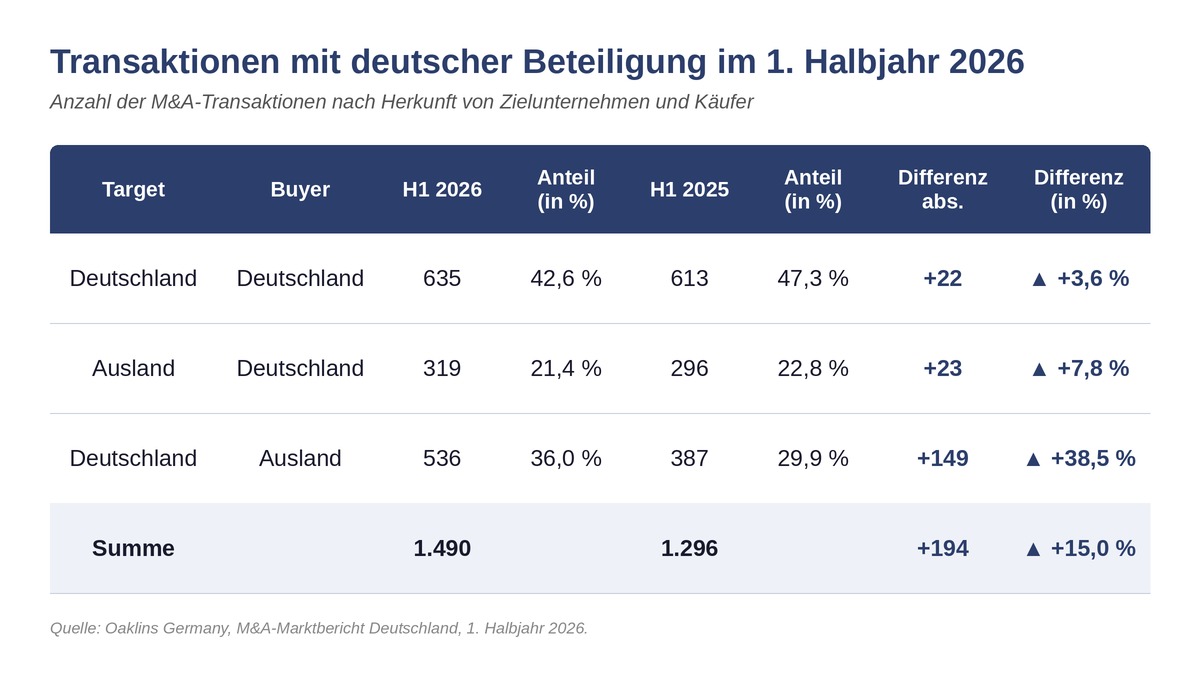
Following a weak previous year, the German market for corporate acquisitions and divestitures grew significantly in the first half of 2026. The latest M&A market report from Oaklins Germany counts 1,490 transactions involving German companies, an increase of 15 percent compared to the same period last year. The trend is even more pronounced in terms of volume. On July 2, 2026, the Frankfurter Allgemeine Zeitung (FAZ), citing financial data provider LSEG, reported a volume of 132 billion U.S. dollars in the first half of the year—nearly double the previous year’s figure; Dealogic even puts the figure at 152 billion U.S. dollars through mid-June. The recovery is driven largely by foreign investors. Acquisitions of German companies by international buyers increased by more than 38 percent, and according to Dealogic, Germany ranks among the top three target countries in terms of the volume of foreign acquisitions, benefiting from valuations that are considered moderate compared to those in the U.S.
It is noteworthy where capital is flowing. While all ten of the largest sectors grew, their relative weights are shifting. The technology, media, and telecommunications sector remains the most active industry with 351 transactions, but with 14 percent growth, it lagged behind the overall market and lost market share over the course of the two quarters. By contrast, capital-intensive sectors such as machinery and component manufacturing, as well as the energy industry, have made significant gains. This is driven, on the one hand, by the question of how artificial intelligence is changing the business models of software providers and how their valuations are responding to this, and, on the other hand, by investors’ growing need for reliability and tangible assets. The FAZ paints the same picture from a practical perspective. Market participants report a lively year for transactions, particularly in traditional industries, while software deals have become rare, and investors now first assess how robust each target company’s business model is in the face of AI.
For small and medium-sized family businesses, this development is good news. The recovery is taking place primarily in the mid-market segment, where strategic buyers and private equity firms are specifically seeking established companies with well-established customer relationships, their own value creation, and a clear niche position. Above-average prices are being achieved primarily by resilient, easily predictable business models. At the same time, demographic trends are increasing the pressure to act. KfW’s January 2026 Succession Monitoring report anticipates approximately 109,000 pending succession cases annually in the SME sector through the end of 2029, while about one in four owners is considering shutting down their business due to a lack of a successor. Experience shows that those who actually want to realize asking prices—which have risen by about one-third since 2019—will not achieve this through a random prospective buyer, but rather through a carefully prepared process involving several qualified prospective buyers. The current environment, with its broad, financially strong buyer base, offers conditions for this that are better than they have been in a long time.
At Albia Capital, we assist owner-managed small and medium-sized enterprises with succession planning and the sale of their businesses, from the initial assessment of strategic options to the targeted approach of suitable buyers both domestically and abroad. As advisors who have ourselves held entrepreneurial responsibility, we know that a sale involves far more than just numbers, data, and facts. Please feel free to contact us at any time—with no obligation and, of course, in complete confidence—if you’d like to discuss this in more detail.